Home Services Early Orthodontics
Early orthodontic treatment in Dallas
The point of an early assessment is not to put a seven year old in braces. It is to find the small number of problems that are much easier to fix while the jaw is still growing, and to confirm that everything else can safely wait.
Why age seven
By around seven, enough adult teeth have arrived to show how the bite is developing, while there is still years of jaw growth left to work with. That combination is what makes the timing useful.
Most children assessed at seven need nothing at all except a review in a year or two. That is a normal and good outcome, not a wasted visit.
Phase one treatment is short and targeted at a specific problem. It is not the full braces stage, which usually comes later once the adult teeth are all through.
Things worth an early look
- A crossbite, where upper teeth sit inside the lower ones when biting down
- Severe crowding, or adult teeth clearly with nowhere to go
- An open bite, where front teeth do not meet when the back teeth are closed
- A jaw that shifts to one side when your child bites
- Baby teeth lost much too early or hanging on much too long
- Persistent thumb sucking past about age five, or mouth breathing
- Difficulty biting or chewing, or speech that has not cleared up
What an assessment involves
-
An assessment, not a sales pitch
We look at how the bite is developing and at the imaging. If nothing needs doing, we say so and put you on a review.
-
If something does need doing
You get the specific problem named, what phase one would involve, how long it would take and what it costs, in writing.
-
Phase one, if it is needed
Usually a short period with a targeted appliance or partial braces to correct the specific issue while growth can still help.
-
A rest, then a review
Most children then wait for the remaining adult teeth. Phase two, if needed at all, is often shorter and simpler because of what phase one fixed.
Who you will see
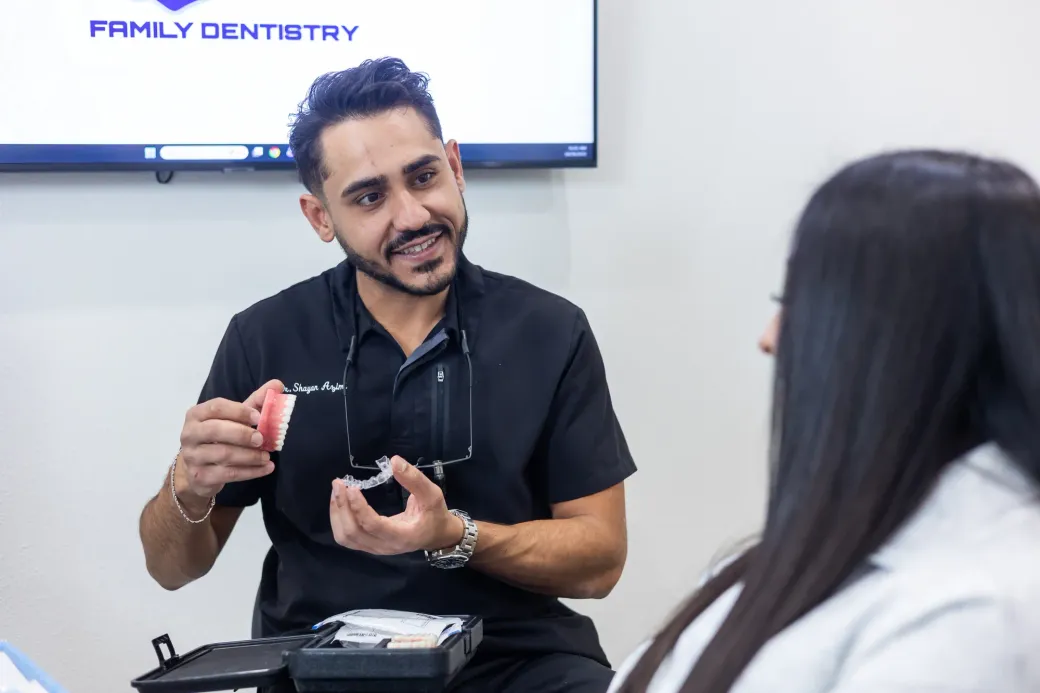
Dr. Jason Nguyen looks after early orthodontics at our Bishop Arts practice. You see the same dentist at every visit, so nobody starts your treatment over.
What it costs, and how people pay
Price depends on what you actually need, so we look first and tell you the number before anything starts. What we can tell you now is how it gets paid for.
- Insured. In network with most major PPO plans, and your benefits get checked before treatment is planned.
- Medicaid or CHIP. Both accepted, which a lot of Dallas practices will not do.
- No insurance. Our membership plan covers cleanings, exams and routine x-rays from $30 a month, with 20% off other treatment.
- Larger treatment. Cherry, Sunbit and HFD payment plans spread the cost.
Early Orthodontics questions
- At what age should a child first see an orthodontist?
- Around age seven. Enough adult teeth are through to show how the bite is developing, while there is still plenty of jaw growth left to work with.
- Does my child need braces at seven?
- Almost certainly not. Most children assessed at seven need nothing beyond a review. Early treatment is for a small number of specific problems that get harder to fix later.
- What is the difference between phase one and phase two orthodontics?
- Phase one is short, early and aimed at one specific problem while the jaw is growing. Phase two is the full alignment stage once all the adult teeth are through, and is often shorter because of what phase one corrected.
- Will early treatment mean my child avoids braces later?
- Sometimes, but that is not the promise. The realistic benefit is that phase two becomes simpler, shorter, or avoids something that would have needed surgery or extraction if left.
- How much does early orthodontic treatment cost?
- It varies with what is needed and is considerably less than full braces. You get the figure in writing before anything starts, and it can be spread across monthly payments.